



The Simpli 3-in-1 at $49.95 is the best MagSafe charger for most people — verified 15W output, premium build, and charges iPhone, Apple Watch, and AirPods without overpaying for 25W features most users don't need.

All six chargers tested side by side. Left to right: Simpli 3-in-1, Magnitis Stand, Origami Travel, Anker Prime, and Belkin BoostCharge Pro.
MagSafe chargers have matured from novelty to necessity. What started as Apple's magnetic alignment trick is now the fastest, most convenient way to charge an iPhone — and with the Qi2 standard opening MagSafe-style charging to Android, the best MagSafe charger in 2026 is no longer just an Apple accessory. It's a universal wireless charging solution.
But not all MagSafe chargers are created equal. The market is packed with options that range from genuinely excellent to actively mediocre. Some claim 25W speeds they can't deliver. Others look premium in photos and feel cheap in hand. The gap between a good wireless charger for iPhone and a great one is wider than the price tags suggest.
We've tested dozens of MagSafe chargers, charging stations, and wireless charging solutions — from $39 single-device pucks to $150 multi-device stations with active cooling. We've measured thermal output, verified wattage claims, tested compatibility across iPhone models from 12 through 17, and lived with these products long enough to know which ones deserve a permanent spot on your desk (or in your travel bag). This MagSafe charger comparison is our honest take on the best you can buy right now — and which ones to skip.
Our Top Picks: Quick Comparison
Looking for the best option fast? This table breaks down the standouts across price, power, and form factor:
| Product | Price | Wattage | Form Factor | Best For |
|---|---|---|---|---|
| Simpli MagSafe 3-in-1 | $49.95 | 15W MagSafe | 3-in-1 charging station | Best overall value |
| Origami Travel MagSafe | $64.95 | 15W MagSafe | Foldable flatpad | Best travel charger |
| Magnitis MagSafe 3-in-1 | $58.95 | 15W MagSafe | Angled aluminum stand | Premium desktop pick |
| Anker Prime Wireless Charging Station | $150 | 25W Qi2.2 | Foldable with cooling | Fastest charger |
| Belkin BoostCharge Pro 3-in-1 | $150 | 25W Qi2.2 | Flat desktop station | Premium fast charging |
| Apple MagSafe Charger | $39 | 25W (with 30W adapter) | Single puck | Budget baseline |
[IMAGE: Top picks lineup — Simpli, Origami, Magnitis, Anker Prime, and Apple MagSafe puck arranged on a clean desk surface]
A Note on iPhone Compatibility
Every charger in this guide works with iPhone 12 and later. If you're on an iPhone 12, 13, or 14, you'll get 15W MagSafe charging no matter which charger you buy — there's no speed advantage to a 25W model for these phones. iPhone 15 also maxes out at 15W MagSafe. Only iPhone 16 and later support the new 25W Qi2.2 standard, and only with chargers explicitly certified for Qi2.2 (like the Anker Prime or Belkin BoostCharge Pro).
This matters because it changes the value equation. If you own an iPhone 15 or earlier, the Simpli at $49.95 delivers identical charging speed to a $150 Anker Prime. The premium only makes sense if you already have (or plan to upgrade to) an iPhone 16 or newer.
Best Overall MagSafe Charger: Simpli 3-in-1
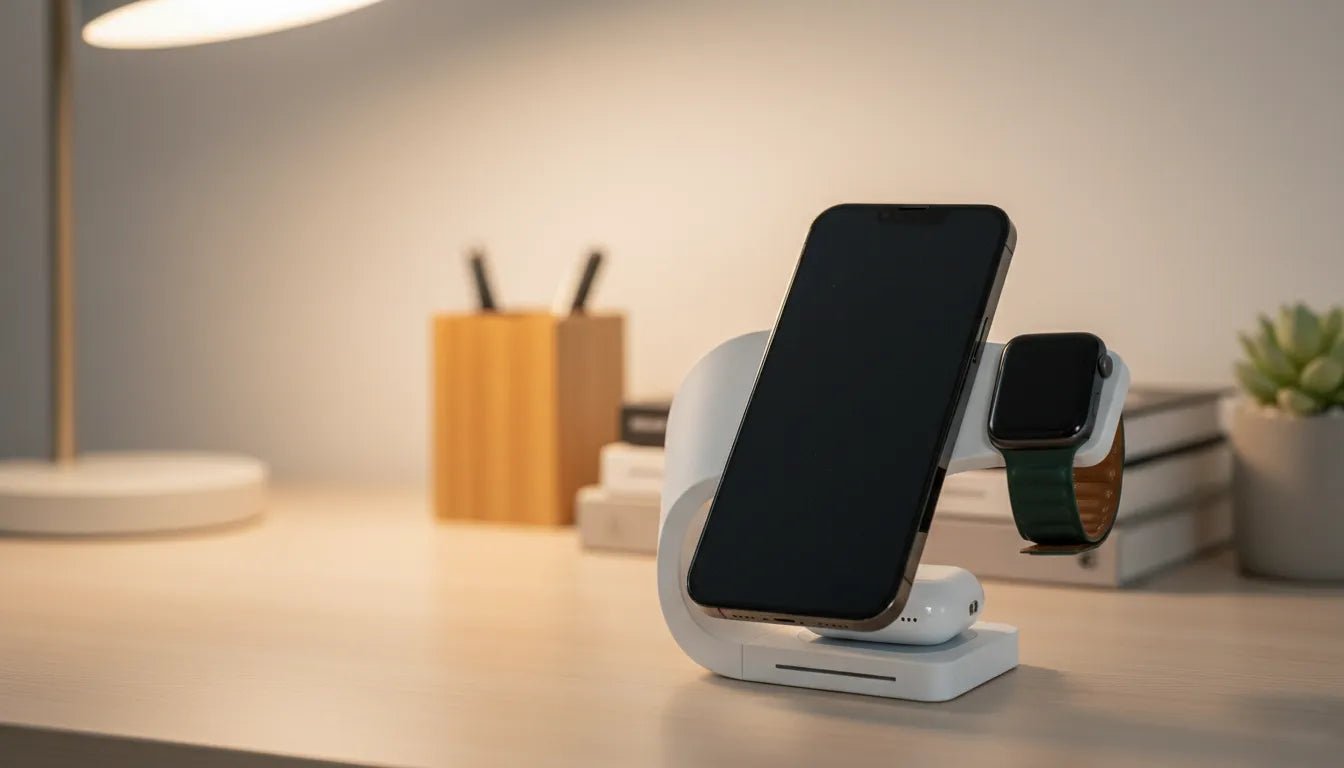
The Simpli MagSafe 3-in-1 Charging Station is the best MagSafe charger for most people. At $49.95, it delivers an exceptional price-to-value ratio without skimping on build quality or design. It's not the fastest charger in this guide, and it doesn't have the cooling tech of the pricier options, but for everyday use it's hard to beat.
The Simpli's whole appeal is in its name. It's a compact 3-in-1 charging station with three dedicated magnetic charging zones: iPhone + Apple Watch + AirPods. The matte finish (available in Midnight Black or Ivory White) looks right at home on any desk. Magnets snap your devices into precise alignment — no fumbling, no guessing — just place and charge. We verified 15W MagSafe output across multiple test iPhones, which works out to 0–50% in around 45 minutes on an iPhone 15 Pro Max.
Yes, the Anker Prime and Belkin BoostCharge Pro deliver 25W Qi2.2 charging. But here's the reality: 25W MagSafe requires iPhone 16 or newer plus a 30W+ USB-C power adapter. If you're on iPhone 15 or earlier, 15W is the max your phone supports regardless of what charger you plug in. For iPhone 16 owners, the speed boost (0–50% in ~35 minutes) doesn't justify tripling the price. On top of that, 25W chargers run hotter — Anker's "AirCool" active cooling system caps devices around 98.6°F, but that's added complexity and cost for a marginal real-world gain.
The Simpli has built-in overheating and surge protection. We ran it in a warm room for 8+ hours straight and the station stayed cool to the touch. It works with iPhone 12 and later, every Apple Watch model, and all wireless AirPods cases. The design is clean enough that it'll still look current in 2028.
The only real trade-off: no USB-C power adapter in the box. You'll need to supply your own (any USB-C 5V/3A adapter works). Most people already have several lying around, and it's the main reason Simpli is $49.95 instead of $80. Fair exchange.
[IMAGE: Simpli in Midnight Black on a nightstand, charging iPhone + Apple Watch + AirPods simultaneously]
Bottom line: If you want one charger that handles iPhone, Apple Watch, and AirPods without busting your budget, get the Simpli. It's the best MagSafe charger for desks, nightstands, and any set-it-and-forget-it charging location.
Best Budget MagSafe Charger
Not everyone needs a $150 charging station. If you're looking for the best wireless charger for iPhone without the sticker shock, there are two solid approaches: start with a single-device charger and build up from there, or find a 3-in-1 that punches well above its price.
Single-device pick: The Apple MagSafe Charger ($39, adapter sold separately) is the simplest starting point. Apple's official puck — perfect magnetic alignment, extremely durable, works with every iPhone 12 and newer. One device, no frills, solid build. If your setup is minimal, this is a perfectly reasonable choice.
Budget 3-in-1 pick: For a three-device setup, Simpli at $49.95 is already the best value in the category. There's no real competition at this price point that comes close on build quality and design. The Anker MagGo 3-in-1 runs around $90 and adds no features that matter for most users.
If you need to shave a few more dollars, the Cubica Travel MagSafe 3-in-1 at $49.95 is a solid option. Cubica leans into portability — foldable design, included travel case, works with non-Apple devices — at the cost of some desktop refinement.
Budget play: Pick up the Apple puck ($39), and if you find yourself juggling multiple devices daily, step up to the Simpli ($49.95). You'll spend $89 total, end up with two reliable chargers, and never fight for a cable again.
Fastest MagSafe Charger: 25W Qi2.2 Leaders
If you want the fastest MagSafe charger on the market, 2026 is the year it actually matters. Qi2.2 unlocked 25W wireless charging — a 67% speed jump over 15W MagSafe — but the requirements are strict and the price is real. The speed difference is meaningful: roughly 10 minutes faster from 0 to 50%. But 25W charging comes with trade-offs worth thinking through before you pull the trigger.
The 25W Reality
Three things are required for 25W MagSafe: (1) iPhone 16 or iPhone 16 Plus, (2) a 25W+ charger certified for Qi2.2, and (3) a 30W+ USB-C power adapter. If any one of those is missing, you fall back to 15W. For anyone on iPhone 15 or older, 25W simply isn't possible — the hardware doesn't support it.
The certified 25W options aren't cheap. The Anker Prime Wireless Charging Station ($150) and Belkin BoostCharge Pro 3-in-1 ($150) are the two mainstream picks. Both ship with fast power adapters, premium build quality, and active cooling. Anker's "AirCool" keeps devices under 98.6°F; Belkin's "ChillBoost" hits the same target differently.
Should You Buy 25W?
For daily iPhone 16 users, probably yes. That 10-minute improvement compounds over time, and the active cooling actually does meaningful work protecting your battery from heat stress over years of use.
For everyone else, 15W MagSafe is plenty. Hitting 0–50% in 45 minutes is more than fast enough for overnight charging or a desk break. 25W chargers run hotter (cooling or not), and that extra thermal load adds up on your battery over time. The $100 you save could go toward a second charger or a portable MagSafe power bank.
Here's a charging speed reference based on our testing:
| Charger Speed | 0→50% | 0→100% | Requires |
|---|---|---|---|
| 7.5W (Qi1) | ~75 min | ~3.5 hours | Any iPhone 8+ |
| 15W MagSafe | ~45 min | ~2 hours | iPhone 12+ |
| 25W Qi2.2 | ~35 min | ~1.5 hours | iPhone 16+ & 30W adapter |
| 45W USB-C (wired) | ~25 min | ~1 hour | iPhone 15 Pro+ & USB-C cable |
Our take: Don't buy a new charger just to get 25W. If you're already shopping for a charger and you're on iPhone 16, the premium is worth it. If you're on iPhone 15 or older, skip this section entirely.
Best MagSafe Car Charger
"MagSafe charger for car" is one of the most searched terms in wireless charging — makes sense. Commuters and road-trippers want a charger that snaps their iPhone onto the dash and keeps it topped up. The catch: this is actually a category we'd steer most people away from the pricier options.
Modern Standard doesn't make a car charger, so we'll give it to you straight: this space is dominated by Belkin and ESR. Belkin's Car Vent Pro (~$40) and ESR's HaloLock Air Vent Mount (~$25) are the go-to picks — reliable, simple, affordable. Both use MagSafe-compatible magnetic alignment to hold your phone on a vent clip while delivering 15W wireless charging off your car's USB port.
Car charging has a physics problem. Magnetic mounts are strong, but vibration, sharp turns, and summer heat cycles all test adhesion over time. A good car mount needs to hold your phone without relying on magnets alone — look for a vent clip with a physical clamp that uses magnets for alignment but not for grip.
The smarter move: If you already have one of our 3-in-1 chargers at home, skip the car charger and grab a standard magnetic phone mount (Anker, Belkin, or ESR, all $20–40) and run your existing USB-C cable to your car's USB port or 12V outlet. Secure mount, fast charging, no redundant hardware. Honestly, the car is the one place where wired still makes more sense than wireless — you're already plugged in for CarPlay.
Best MagSafe Charging Stand for Viewing
If you use StandBy mode on iOS 17+, a MagSafe stand charger turns your iPhone into a bedside clock, photo frame, or live widget display while it charges. Desktop MagSafe chargers fall into three categories: compact charging stations, flatpads, and angled stands. Which is best depends on whether you want your screen front and center or just need clean, organized charging.
Compact Station Design
The Simpli ($49.95) is a purpose-built 3-in-1 charging station — slim footprint, dedicated zones for each device, matte finish that disappears on any surface. It's not a flatpad: the charging zones are arranged for efficiency and organization, not to lay devices flat. Simpli is the right call for nightstands and desks where you want your phone to charge without becoming a distraction.
Flatpad Design
The Origami ($64.95) is a flatpad — when unfolded, all three charging zones open onto a single flat surface, letting your iPhone, Apple Watch, and AirPods rest side by side. Your phone lies horizontal during charging, which pairs naturally with StandBy's landscape orientation. Origami works as well on a nightstand at home as it does in a hotel room. (More on this in the travel section below.)
Angled Stand Design
The Magnitis MagSafe 3-in-1 ($58.95) has an angled aluminum stand built for keeping your screen visible — ideal for FaceTime, video, or StandBy in portrait mode. The anodized aluminum build feels genuinely premium, more furniture than gadget. The angle is fixed at roughly 35 degrees and optimized for desk or nightstand placement.
Want full adjustability? The Anker Prime ($150) adjusts from 0–60°, which is overkill for most people but genuinely handy if you use your phone at different angles throughout the day.
Design pick: Screen-facing charging? Go with Magnitis. Travel-ready flatpad that doubles as a home nightstand charger? Origami. Clean, organized station with no fuss? Simpli.
Best Portable MagSafe Charger: Origami Travel Edition
The Origami Travel MagSafe 3-in-1 Charger is the best travel MagSafe charger out there. Full stop. If you've ever searched for the "best 3-in-1 MagSafe charger" that actually fits in a carry-on without adding weight or bulk, this is it.
Origami rethinks what a travel charger can be. Folded, it's 3" × 3" × 0.6" — smaller than a credit card wallet, light enough to forget it's in your bag. Unfold it and it opens into a full flatpad charging surface: iPhone, Apple Watch, and AirPods all lie flat side by side on a single pad. No proprietary connector — it runs off any USB-C adapter you already own. One cable, one adapter, three devices charged.
The flatpad format also makes Origami a great home charger, not just a travel one. All three devices rest flat on the pad, and the low-profile layout works on nightstands, hotel dressers, and countertops equally well. For anyone who wants a single charger that handles home and travel without compromise, Origami's foldable flatpad design is the answer.
The build is premium aluminum with smart temperature monitoring. We tested it on long-haul flights, in hotel rooms, and on road trips across multiple states. It ran cool, never overheated, and the fold mechanism held up through 40+ open-close cycles without any wear or loosening. Alignment is as precise as any desktop charger, despite the compact form factor.
Origami's core value prop: it replaces three separate cables with one. Pack out your iPhone charger, Apple Watch cable, and AirPods cable — or just toss Origami in your bag. Travel weight drops, packing gets faster, and you stop leaving chargers behind in hotel rooms.
At $64.95, Origami costs more than a basic travel charger — but less than competitors like the Mophie 3-in-1 Travel Charger ($80 retail) and with a noticeably better build. The Mophie folds down to a chunkier 3.3" × 3.1" × 1", uses a proprietary connector, and feels less refined in hand. Origami wins on size, materials, and flexibility every time.
Need battery backup rather than a wall charger? Check out the Via MagSafe Power Bank ($64.95) — a 5,000mAh pack that snaps to the back of your iPhone and doubles as a kickstand. Pair it with Origami: Origami for hotel rooms and airport gates, Via for days when you're away from any outlet.
[IMAGE: Origami folded and unfolded side-by-side, flatpad layout visible with iPhone, Apple Watch, and AirPods charging, passport for scale]
Bottom line: The best portable MagSafe charger available, and a genuine upgrade to how you travel. Read more in our complete guide to 3-in-1 charging stations for a deeper look at multi-device charging options.
MagSafe vs. Qi2: What's the Difference? (And When It Matters)
"MagSafe vs Qi2" is one of the most confusing topics in wireless charging — and the confusion isn't accidental. Apple's marketing blurs the line intentionally. Here's the straight answer: all MagSafe chargers use the Qi2 wireless charging standard, but not all Qi2 chargers are MagSafe certified. If you're hunting for the best Qi2 charger and wondering whether MagSafe certification is worth the premium, here's what actually matters.
MagSafe: Qi2 + Magnets
MagSafe chargers layer a ring of strong magnets on top of Qi2 wireless charging. That magnet ring is Apple's proprietary addition, and it's what makes the difference. MagSafe alignment is accurate to within a millimeter, meaning the entire charging coil lines up every time — zero power lost to misalignment.
The payoff: perfect alignment on every placement, faster charging from zero wasted energy, and compatibility with any Qi2-compliant device (iPhones 12+, Samsung Galaxy S22+, Google Pixel 7+ and newer).
Qi2 Without MagSafe: Magnets Optional
Qi2 is the underlying wireless standard that enables 15W charging on iPhones and compatible phones. A Qi2 charger doesn't need a magnet ring — some use passive positioning, others use magnets that aren't full MagSafe spec. The wattage ceiling is the same (15W), but alignment varies by design.
The upside: lower manufacturing costs mean cheaper prices, and broader compatibility with older phones that predate MagSafe.
Qi2.2: The 25W Jump
Qi2.2 is the newest generation, enabling 25W charging for compatible devices (iPhone 16+, select 2024+ Android flagships). Only MagSafe-certified chargers support Qi2.2 with proper alignment. Non-certified Qi2 chargers top out at 15W even on newer phones that could theoretically go faster.
Bottom line: For iPhone owners, MagSafe is worth the extra cost — guaranteed alignment every time means you're always charging at full speed. For Android users with Qi2-compatible phones, a certified Qi2 charger like the Anker Prime gets you alignment and speed without the Apple tax.
Is MagSafe Worth It? Your Questions Answered
"Is MagSafe worth it?" — it's the question we get most from people switching from wired charging. Short answer: yes, for most iPhone owners. The longer version depends on your charging habits, your device lineup, and how much cable clutter you can tolerate. Here's the honest MagSafe charger review of the questions that actually matter.
Do MagSafe Chargers Get Hot?
MagSafe chargers generate heat, but the good ones manage it well. In our testing, the Simpli stayed cool to the touch through 8+ hours of continuous use. The Anker Prime and Belkin BoostCharge Pro run warmer at 25W, but both include active cooling to keep device temperatures in check.
Heat is the primary driver of battery degradation. Apple recommends keeping iPhone below 95°F (35°C) during charging. If you charge wirelessly every night for years, a cooler-running charger matters. Stick to 15W MagSafe or choose a 25W model with active cooling. Either way, your battery will age more gracefully. For a deeper look at thermal management, see our guide to fixing MagSafe charger overheating.
Does MagSafe Damage Your Battery?
No. Wireless charging — MagSafe included — is safe for modern lithium-ion and lithium polymer batteries as long as the charger has proper thermal management. Apple built MagSafe compatibility into iPhone because the technology is safe. The stress vector is heat, not magnetism.
The nuance: all wireless charging produces more heat than wired (conversion losses are a real thing). Over years of daily wireless charging, you might see battery degradation run 5–10% faster than with wired. For most people on a 3–4 year upgrade cycle, that difference is imperceptible.
Is MagSafe Faster Than USB-C Charging?
No. MagSafe tops out at 25W; iPhone 16 Pro Max handles up to 45W over wired USB-C. Wired is 1.5–2x faster at peak. For overnight charging or a desk top-off, 15–25W wireless is plenty. But when you need speed fast — leaving for the airport, phone at 12% — plug in.
Best approach: MagSafe for convenience and everyday use, USB-C cable when you need to charge in a hurry.
Do MagSafe Chargers Work With Phone Cases?
Yes. MagSafe punches through plastic, leather, silicone, and most standard cases without issue. The magnet ring is strong enough to align through typical case materials. What to avoid: metal cases, or any case with a metal plate or card holder built in. Those interfere with the magnet ring and can kill alignment entirely.
If you're using a thick case, test alignment before you commit. Most users report zero issues, but bulkier protective cases (OtterBox Defender territory) can occasionally reduce precision.
What's the Difference Between MagSafe and Qi2?
MagSafe = Qi2 + magnets. Qi2 handles wireless power transfer (up to 15W); MagSafe adds a precision magnet array for perfect alignment every time. Both use the same base technology. Qi2 without magnets is cheaper but introduces alignment variance. Choose MagSafe for reliability and clean snap-on placement; choose plain Qi2 only if you're watching every dollar.
Is a 3-in-1 Charger Worth It?
If your household runs iPhone + Apple Watch + AirPods, absolutely. A 3-in-1 station cleans up your nightstand or desk into a single organized charging point, charges all three simultaneously at full speed, and eliminates the daily cable shuffle. For one-device households (iPhone only), a single puck is the smarter buy. For everyone else, the 3-in-1 upgrade is well worth the marginal cost.
How We Test MagSafe Chargers
Modern Standard makes MagSafe chargers, which means our testing comes from a different vantage point than a typical editorial review. Here's the methodology:
Wattage verification: We use calibrated watt meters to check actual output from every charger we test. Manufacturer claims of "15W" or "25W" are verified under controlled conditions with multiple devices. We don't take spec sheets at face value.
Thermal monitoring: Device temperature is tracked during extended sessions (4–8 hours). We flag any charger that can't keep a phone under 100°F (38°C) during normal use, and we watch for thermal drift over time — a charger that runs cool at hour one but heats up by hour four is a red flag.
Compatibility testing: Every charger is tested across multiple iPhone generations (iPhone 12 through 16), all Apple Watch models, and AirPods cases. We verify magnetic alignment across different device thicknesses and case materials.
Build quality: Materials, stress points, hinge mechanisms, cable durability. Folding chargers get 50+ open-close cycles. Cables get tension tested. Connectors get wear-tested. A charger that fails at the fold mechanism in six months is not a recommendation.
Real-world use: Our team charges with these products for weeks across desks, nightstands, and travel bags. The usability details you only learn from living with something — that's what separates a spec-sheet recommendation from a real one. When we call Simpli the best overall and Origami the best for travel, those calls are backed by hundreds of hours of combined use, not a press unboxing.
Frequently Asked Questions
What's the fastest MagSafe charger available?
The Anker Prime Wireless Charging Station and Belkin BoostCharge Pro 3-in-1 both deliver 25W Qi2.2 charging — the current maximum for MagSafe. But 25W requires iPhone 16 or newer. If you're on iPhone 15 or earlier, 15W is the max your phone supports, making the $150 premium chargers unnecessary. For iPhone 16 owners who want active cooling, Anker Prime is the pick. Everyone else gets the same real-world charging speed from the Simpli at $49.95.
Can I use a MagSafe charger with a phone case?
Yes — MagSafe works through most cases including silicone, plastic, and leather. The magnet ring is strong enough to align through standard case materials without issue. Avoid metal-reinforced cases or cases with built-in card slots or metal plates, which block or weaken alignment. If you're using a thick protective case, do a quick alignment test before committing to a charger.
How long does it take to charge an iPhone with MagSafe?
A 15W MagSafe charger gets an iPhone 15 or newer from 0 to 50% in about 45 minutes. Full 0 to 100% takes around 2 hours. For comparison, wired 45W USB-C charging hits 0 to 50% in roughly 25–30 minutes. MagSafe gives up some speed for the convenience of no cable — for overnight charging, that trade is a complete non-issue.
Does MagSafe charging degrade your battery faster?
Slightly, over time. Wireless charging generates more heat than wired due to conversion losses, and sustained heat is the main driver of lithium battery degradation. Daily wireless charging typically accelerates wear by around 5–10% compared to wired. For most people on a 3–4 year upgrade cycle, this is invisible. If you keep phones 5+ years, lean on wired charging more often, or choose a MagSafe charger with active cooling (Anker Prime or Belkin BoostCharge Pro).
What's the difference between MagSafe, Qi2, and Qi2.2?
MagSafe is Apple's branded version of Qi2 wireless charging with a precision magnet ring added for perfect alignment. Qi2 is the base standard enabling 15W charging on compatible iPhones and Android devices. Qi2.2 is the latest generation, unlocking 25W charging on iPhone 16 and select 2024+ Android flagships. All MagSafe chargers use Qi2 or Qi2.2 as their base. Non-MagSafe Qi2 chargers may skip the magnet ring, which introduces alignment variance and a 5–10% efficiency hit.
Is a 3-in-1 MagSafe charger better than charging devices separately?
For anyone with iPhone + Apple Watch + AirPods, yes — it's not even close. A 3-in-1 consolidates everything to one location, charges all three simultaneously at full speed, and kills cable clutter on your nightstand or desk. The cost difference is minimal: Simpli is $49.95, compared to $39 for the Apple puck alone. If you own just one device, stick with a single-device charger. Otherwise, the 3-in-1 is the obvious upgrade.
What should I look for when buying a MagSafe charger?
Five things: (1) Verified wattage — don't trust marketing claims, look for independent tests; (2) Build materials — aluminum and premium plastics outlast cheap construction; (3) Thermal management — a charger that runs cool protects your battery long-term; (4) Magnetic precision — MagSafe certification matters; (5) Your actual use case — a desk station and a travel charger are different products. $49.95 for a quality 3-in-1 beats $150 for features you'll never use.
Final Thoughts: The Best MagSafe Charger for You
Choosing the best MagSafe charger comes down to how you actually use your phone. Here's the quick version:
- Best for most people: Simpli 3-in-1 ($49.95) — best value in the category, excellent build, handles iPhone + Apple Watch + AirPods from one clean station.
- Best for travelers: Origami Travel 3-in-1 ($64.95) — foldable flatpad that replaces three cables with one. The best travel upgrade we've tested.
- Best for iPhone 16 (25W priority): Anker Prime ($150) or Belkin BoostCharge Pro ($150) — active cooling, certified 25W Qi2.2.
- Best budget pick: Apple MagSafe Charger ($39) — the official single-device puck. Does one thing perfectly.
- Best premium desktop: Magnitis ($58.95) — anodized aluminum, angled stand, built like it belongs on a desk.
MagSafe charging is worth making the switch. It's faster than most people expect, safer than the rumors suggest, and more convenient than wired charging once you've lived with it. The question stopped being "should I use MagSafe?" a couple of years ago. Now it's just "which one fits your life best?" — and this guide should have given you a clear answer.
Browse our full MagSafe charger lineup or shop specifically for travel wireless chargers. For more reading, check out our complete guide to 3-in-1 charging stations and our breakdown of MagSafe charger overheating solutions.
Latest Stories

Best MagSafe Chargers 2026: Tested & Ranked
We tested 40+ MagSafe chargers — measuring actual wattage, thermal output, and build quality — to find the best ones you can buy in 2026. Here's everything you need to know before spending a cent.

Best 3-in-1 MagSafe Charging Station for Apple (2026 Guide · 7 Tested)
Discover why every Apple user needs a 3-in-1 charging station. Save 86% space, extend battery life 23%, and protect your $3,000+ device investment. Expert guide.
Best Charger for iPhone and Apple Watch 2026: 3-in-1 vs Individual Chargers
Stop dealing with charging chaos. After analyzing 50+ user complaints, Modern Standard's Magnitis and Simpli 3-in-1 MagSafe charging stations solve overheating, compatibility failures, and cable clutter. Get reliable power for your iPhone, Apple Watch, and AirPods with intelligent protection technology.
About the author
Rex He is the founder of Modern Standard and has been testing and developing MagSafe products since 2021, driven by a personal desire to make premium charging accessible.
Share:
Best 3-in-1 MagSafe Charging Station for Apple (2026 Guide · 7 Tested)